You know that great picture of my back in the last post? That is a picture of when Her Majesty Clare was handing out these GORGEOUS pewter tokens made by the Laurel she is apprenticed to, Mistress Gilliana Attewatyr. She made one for each of the participants. Badges for our own little pilgrimage of sorts.
The little scissor charm I found tucked into my notebook of documentation and I heard they were given out by Mistress Rebecca. Such a sweet charm.
So, now I'm staring at them and trying to figure out how best to display them. What sort of thing do they need to become?
I'm vaguely toying with the idea of putting the badge on a needlebook to tuck in with my other sewing tools. I could certainly make it into a scissor fob. There's also the option of stitching it to my pilgrim hat where I have been collecting my other pewter bits from site tokens and such, but I rarely wear it. Not that it isn't a fun hat, but it doesn't go so well with either of my sets of garb. my daughter suggested I make a felt band and attach it around my basket to show things off. her primary motivation is that she wants the hat. Its an unblocked felt one and she's sure it should be a cowgirl hat. I know a needlebook would get use, and lots of it. Just wondering if the badge deserves something cooler, and what exactly that would be. Whatever it is, I think the scissors will end up dangling from it so I can utilize the pretty braid its attached to.
As Poohbear would say, "Think. Think. Think."
Wednesday, January 11, 2012
Didn't get pictures at 12th night, but here's some of me in the background
My friend Megan was kind enough to let me share a couple of pictures she took at 12th night. Not many got taken, but I intend to remedy that this weekend and have my friend Davey take some good pictures of the dress and accessories.
And, in case you wanted to see the back.
Tuesday, January 10, 2012
Camicia
The cut of my camicia is based on an extant piece held in the Victoria and Albert Museum in the UK. I based my pattern off Dorothy Burnham's examination of it in her book Cut My Cote with additional information provided by Annabelle Wake in her article "How to Sew a Venetian Camicia" I also consulted Janet Arnold's Patterns of Fashion 4 where several Italian camicias are discussed. Because I am quite a bit taller and larger than women in 16th century Italy I chose to be much more generous with my widths of fabric, rather than following Ms. Wake or Ms. Burnaham's recommendations.
As my last camicia was a rather fancy one with a lot of lace inserts, I made this one very plain. It is also in keeping with the portrait I chose to base my ensemble on. The portrait has a plain camicia with integral pleated ruffle at the neck and cuffs. I followed the instructions at Realm of Venus for a gather pleated neckline, pleating and then backstitching over the pleats. In period fine linen would have been used. I also used a lightweight white linen fabric, but it is not of the fineness of linen in period as modern commercial linen does not approach the thread count of fabrics from the 16th century. Assembly was a combination of machine and hand work. I finished each panel and the gussets with machine hems, but did the insertion stitches to connect them by hand and hand pleated the neck and cuffs. After wearing it once I decided that the backstitch I did over the pleats to secure them needed extra reinforcement and did a decorative machine stitch over the top of the pleating.
Monday, January 9, 2012
Pincushion
Small pincushions made to dangle from sweetbags began to gain popularity in the late 16th and early 17th century. This is a tough object to document as it is part of an intended larger set. Eventually I plan to make a larger bag for holding sewing essentials, a knife sheath, needlecase and penner all embroidered in style and motif similar to the pincushion. For now, however, I have only the pincushion.
I decided to hang it from the saccocia/pocket as there is a fresco featuring a saccocia with attached cone shaped needlecase. By Alessandro Allori, “ A Woman at her Toilet,” is dated between 1575 and 1578 and resides in Florence, Italy in the Gaddi Chapel of the Church of Santa Maria Novella. The needlecase dangles from the bottom.
I made several unsuccessful attempts to make a similar needlecase but was not able to with the materials I had to hand. Having a similar needlework implement in the same place seemed to me like a reasonable substitution. I plan to keep scissors in the pocket itself and needles and pins accessible in the pincushion.
My pincushion is probably more English than Italian in design as the sweetbags are more particularly English. However, there is an extant Italian needlecase, probably from Venice, embroidered in a style very like the English knife sheathes that are often seen as part of sweetbag suites. The frequent use of Italian patterns and design for English embroidery and pattern books makes me feel pretty comfortable in planning a bag, pincushion and needlecase suite down the road, even if documenting the pincushion dangling from the saccoccia right now is a bit dodgy.
I had planned to design and stitch a heart and fleur and surround it with a floral design, but after drawing it up I quickly realized that embroidering something like that wasn’t going to happen right now. Instead, I found a floral design that was machine embroidered and appliqued it in the period manner. Again, my research is more English than Italian, but embroidered floral slips were often done on linen and then cut and appliqued on to other fabrics. The method of applique involved stiffening or sealing the edges of a piece cut out from the fabric with either glue or a wheat paste, placing it on to the fabric to be appliqued to and couching gold threads around the slip. The edges were not folded under, but instead held down by the couched gold. I appliqued my floral slips in this same way.
The pincushion is made of silk left from my dress stuffed with wool. I couched gold cord around the edges , leaving a loop of it to hang the pincushion from and finished it with the same tassels I used for my tassel bag. Sweetbag tassels are usually a little different than this, being an unusual type. When and if I finish the suite, I intend to change the tassels.
Sunday, January 8, 2012
Pewter, silk, pearls, and tassels
Since no one had the time to read my documentation at 12th Night, I figured I'd just finish up posting the last few items I made to go with the patchwork dress.
A little drier than normal, but I'll try to throw in a few jokes to keep y'all on your toes.
First up, my poste (actually probably a sottoposte because its a lesser quality of silk) a silk scarf to be used as a belt.
As my dress is a transitional style from the 1530’s and the portrait does not have a waist ornament, there are a couple of possibilities as to what could be worn with it. To give myself some options, I decided to make a poste or silk belt sash. Poste were an extremely popular export item of the Venetian silk industry. They were worn by both men and woman throughout Italy and the general use scarves were exported throughout the continent. Originally fine scarves intended for a variety of uses, as the 16th century went on, they became more and more narrow. By the second quarter of the 16th century they were sometimes described as narrow as eight inches. They were decorated with velvet, tassels and other ornaments.
Although Bacchiacca’s painting, “The Preaching of Saint John the Baptist” is earlier than my dress, it provides a good look at a long poste with tassels. I have included several other paintings with silk sashes tied at the waist that have more in common with my dress (balzo, full upper sleeves etc.)
Bacchiacca’s The Preaching of Saint John the Baptist
Portrait of a Woman by Paolo Zacchia the Elder
Bacchiaca
In making my sash, I chose to use a scrap of bronze silk and blue cotton tassels made from crochet cotton. I added a blue decorative stitch on the edges using my sewing machine. To add further weight to the tassels, I topped them with pewter castings of my krin (heart with fleur) badge. The castings are my first attempt at pewter casting, made in a class HRM Clare and Mistress Giliana taught at Collegium. I carved the mold in class and we poured the castings at that time. I filed them at home and drilled some holes in order to attach them to the sash. For further decoration, I painted them copper and bronze with enamel paints and stitched through pearls that seat into the drilled holes.
References used:
The Silk Industry of Renaissance Venice by Luca Mola p. 168
Sugar and Gamurre’s article on poste.
Sunday, January 1, 2012
Nosegay with beaded heartsease
Nosegays, posy's or small bouquets are often seen in portraits. This portrait by Niccolo dell'Abbate is one of the closest correspondences to my preferred area. He was known to have painted in the Emilia-Romagna area. The sitter has a small balzo and zibellino and her dress style seems to close to my 1530's-40's. Other portraits of interest are this one by Santi di Tito of a young woman with a bouquet of fresh flowers and what seem to be faux flowers of beads and silk in her hair and Flora by Tinteretto with a lovely small nosegay tucked into her bodice.
Because of the time of year, fresh flowers and plants are not particularly available, so I tried to think ahead. I have been keeping culinary herbs, and as luck would have it, several of them are used for their small and symbolism in nosegays. Jadwiga Zajaczkowa mentions both rosemary and thyme in her article "Medieval herbs for the very small garden." Rosemary was part of marriage wreaths as well as being "put in tussy-mussy flower bunches to ward off vermine and noxious smells." Thyme is referenced as well (albeit from a rather suspect 1941 source) "it used to be the custom for maidens to wear a nosegay of sprigs of thyme, mint and lavender to bring them sweethearts."
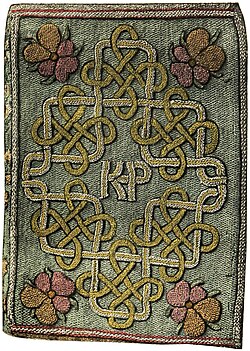
Shakespeare's Ophelia also makes mention of "Rosemary for remembrance" and "pansies for thoughts." Pansies (or heartsease as they are also called) also show up in blackwork patterns and are embroidered on several extant English coifs. They were a rather popular for embroidery, especially as Queen Elizabeth I used them as a badge. At age 11 she embroidered a book cover for Katherine Parr with pansies in each corner and a second book a bit later, also with heartsease.
Since I wasn't going to find those sorts of flowers in December, I decided to try something different. Faux flowers were very popular in the 15th and 16th century. Silk ones were very common, but beaded ones did exist. Particularly in Venice where they were made by poor women from cast offs from the glass making industry. Beaded flowers were a lower and middle class item most usually, as the upper classes could afford more expensive materials and had their faux flowers made from gold and jewels. I, however, do not have access to a lot of gold and jewels. I ran across Roxelana Bramante's research into beaded flowers (as well as incredible stuff on silk flowers)and have wanted to try making a few ever since. This seemed the opportunity.
As this was a first attempt and I was working with stash materials, I went with much larger beads. I used blue and gold glass beads to match my dress and a small amber carved leaf for the center piece. They are made using very basic French beaded flower techniques. They're just strung on wire and twisted into shape. Roxelana mentions that it would have been iron wire used in period. I used steel 22 gauge paddle wire. The resulting flower is very oversized comparared to the delicate pieces that would have been made by Venetian beadstringers for sale, but I am happy with it as a first attempt. I would like to make some further pieces out of smaller beads with more intricate patterns in the future.
To make the tiny nosegay, I clipped a few sprigs of rosemary and thyme and arranged them with the beaded heartsease. The fresh herbs are wrapped in a bit of damp cotton and the entire posy is wrapped in a scrap of silk and tied with ribbons. When I wear the dress, I do plan to do a larger nosegay and add a few more sprigs of the herbs but I didn't want to snip too much and hurt my herb plants.
Cost $0
Culinary herbs grown for my kitchen use with fabric, ribbon, wire, and beads from stash.
Categories:
Fief Holding:Gardening and horticulture
Glass:Other
Breakdown of budget
This is more house keeping, as I put together my documentation for 12th Night, but I needed somewhere to post info.
Budgetwise I was rather surprised. I totally ignored budget, intending to sacrifice some accessories upon the sacrificial altar and exchange their points for not having to worry about it. From the rules "If your expenses are over $100, you will be penalized 1 point for every $10 over $100." One extra accessory is worth 10 points, so following that out to its conclusion, if you make one extra accessory and are willing to not get any of its points that gives an additional $100. If you were to use an entirely new talent and get all 10 of those points you could get $200 (or more, depending on how many new talents used) from the accessory. So, for example, my shoes are Costuming:Footwear and therefore a new category. They have wet felted insoles and felt lining Textile Arts:Non-woven, are Leatherwork:functional, and have leather applique Leatherwork:Decorative. The applique is of my heraldic badge Heraldic Display: clothing. So, conceivably, the slippers could come out to 60 points on their own and give me an extra $600 to play with. Granted, that's probably silly and I wouldn't get the full points, but looking at it that way it seems totally worth it to make an interesting accessory and not worry about budget. It more than pays for itself.
I originally planned to just have "budget accessories" where I didn't bother to calculate the points and gave up the points to create a budget pool that I couldn't possibly spend. I got curious yesterday though and I calculated the budget just to see since I'd ended up using so much stash materials. My total was $107.67. So, I actually only have 1 penalty point.
Granted, as my husband points out, when I went shopping for the things I used in the dress I spent a lot more than that. For example there was the trip yesterday to JoAnn's for a hook and eye for the skirt. I did not in fact end up needing the hook and eye once the dress was laced so its not in the final budget tally. I did buy hook and eyes, however. They also had their clearance fabrics 50% off and there was this gorgeous gold cotton with the perfect Venetian pattern. I came home with a little over 11 yards at $4.50 a yard. And a quilted red for a petticoat to go with it. And some more sewing machine needles. And a new pair of scissors since my good ones got used for wrapping paper cutting. So the $0 cost to my dress budget wasn't actually $0. I spent $108. Gandhi feels that should be included in the budget. I, on the other hand, am pleased with my new stash fabrics that need to cure a bit in stash before being used.
If you are bored enough to read the budget breakdown, here it is.
Layers-
Skin layer- White linen camicia. Pieces all machine sewn and then assembled by hand with an insertion stitch. Hand pleated. Cost $0. Traded massage for 5 yards of white linen. Threads from stash. Pearl buttons from stash.
Main garment-Dress. Blue and orange patchworked silk. patchwork by machine and interior long seams are machine sewn. All pieces are hand finished and whipstiched together. Cost $39.47. 6 yards of blue silk purchased for $5 a yard. Plastic boning material purchased for $8. Buttonhole thread used for cartridge pleating purchased for $1.47. Orange silk from stash. Wool felt from stash. Grey twill used for lining, interlining, and boning layers from stash. Thread from stash. Sleeves and baragoni were not completed by deadline.
Warmth layer- Mantellina. Brown velvet lined in brown shearling with a decorative lining of copper dupioni silk. Entirely hand sewn. Cutwork, fur use, and pearl beading. Cost $0. Traded massage for shearling hide. Silk, pearls, threads, and velvet all from stash.
Accessory- Peacock feather fan. Wood handle constructed from purchased wooden table leg turning, pressed wood decorative filigree and wood putty. Pad of fan is made from leather. Peacock feathers are stitched and glued into place. Handle was painted, gilded and enhanced with metal filigree, pearls, paua shell, and blue beads. Cost $28.50 $20 for 100 peacock feathers, $5 for the table leg and $3.50 for the filigree wood pieces. Gold leaf, white paint, wood putty, leather, filigree, paua shell, and other beads from stash.
Additional garments and accessories
1.Gold coverciere/partlet Purchased fabric hand hemmed. Cost $4 for 1/2 yard of fabric. Thread from stash.
2.Salmon linen petticoat with chestnut linen lining. Corded with green ribbon accent. Hand sewn eyelets. Machine sewn and hemmed with hand cartridge pleating. Cost $0. All materials and threads from stash.
3.Blue linen drawers with embroidered cuffs trimmed in lace and buttons. Entirely machine sewn. Cost $0. Material, buttons trim, lace and threads from stash.
4.Particolor leather slippers. Blue and tan leather slippers with heart applique with hard interior leather sole. Lined in wool. Machine sewn. Cost $0 Leather and wool from stash
5.White linen stockings with lace cuffs. Cost $0 Lace from stash, linen remnants of traded length from camicia. Machine sewn with hand finishing.
6.Blackwork garters with buckles and tassels. Cost 20 cents Tangerine silk from IRCC prize. Buckles traded for massage. Aida bands purchased as a large lot from the thrift store for $2 (100 yards. I used 2 yards.)
7.Orange silk saccocia lined in navy blue linen trimmed in orange and metallic trim. Cost $0 materials and trim from stash
8.Rosary of gold beads with filigree dangle and bow finial. Strung on black silk. Cost $0. All materials from stash
9.Fur lined muff with pearl buttons.. Cost $7. Vintage chincilla stole from stash cut for fur. Purchased fabric for outer. Trim from stash. Pearls from stash. threads from stash
10.Tasseled bag with purse weight. Cost $7 purchased fabric. Purse weight from stash. Chain from stash. Tassels made from fringe for parasol. Lined with scrap silk.
11.Nosegay from flowers I grew/dried/ or made. Cost $0
12. Jewel sculpted from polymer clay and gilded. Cost $0 Sculpy from stash, gold leaf from stash, acrylic gems from stash, chain and clasp from stash.
13. Comb carved from wood painted and gilded. Cost $0 Wood scavenged. Painting supplies and gold leaf from stash.
14. Blue and gold girdle. Cost $0 Blue beads and gold plaques from stash.
15. White apron with orange accents. Cost $0 White linen scrap. Lace and trims from stash.
16.Pearl drop earrings. Cost $3. Leverbacks and blue beads from stash. Purchased glass teardrop pearl strand for $3
17. Pearl necklace. Cost $0 Freshwater pearls, wire, and clasp from stash.
18. Pearl girdle with tassel Cost $7 for purchased tassel. Wire, gold plaques and freshwater pearls from stash.
19. Paper and filigree flag fan. Cost $0. Wood handle, metal filigree bits, pearls, paint, and Bristol board from stash.
20.Chainmaille bracelets Cost $0 10mm jumprings and filigree clasps from stash.
21. Turban. Cost $0 Copper silk and cotton fringe from stash
22. Gold and blue hair ornament Cost $0 Wig clips, beads and plaques from stash
23. Ghirlandia Cost $0 Wool yarn curled over a wool base with copper tone ribbons.
24. Silk sash (poste) with cast pewter terminal decorations and tassels. Cost $0? I used the pewter castings I made of my heraldic badge at Collegium adding enamel paint. Copper silk hand hemmed from stash. Tassels made of cotton floss from stash.
25. Handkerchief. Cost $0. Scrap linen with purchased lace inserts.
26. Zibellino Cost $0. Materials purchased before start of contest. Fur with sculpted polymer clay head with filigree and bead accents.
27. Chopines Cost $0. Scrap wood from my father. Leather, trim, and upholstery nails purchased from project before contest started.
28. Street veil with tassels Cost $0 Black cotton gauze from stash. Tassels made from crochet cotton. Trim hand made of gold and black crochet cotton from stash.
29. Parasol with fringe Cost $6.50 Purchased umbrella frame for $5. Fringe purchased for $1.50 from thrift store. Other materials from stash
30. Blue leather gloves Cost $0 Traded massage for pigskin.
31. Zimarra Cost $0 Fabrics from stash. Buttons and trims made from crochet cotton in stash.
32. Walking sticks Cost $5 for dowels. Paint, beads, and other materials from stash
33. Blue and orange with gold pincushion. Cost $0 Materials in stash
34. Larva mask. Cost $0 Molded from buckram in stash, covered in stash fabric with ribbons and paint from stash.
35. Accordoletta. Silk fingerloop braids adapted for braiding on the marudai Cost $0 Silk threads from IRCC prize.
Total cost $107,67
Budgetwise I was rather surprised. I totally ignored budget, intending to sacrifice some accessories upon the sacrificial altar and exchange their points for not having to worry about it. From the rules "If your expenses are over $100, you will be penalized 1 point for every $10 over $100." One extra accessory is worth 10 points, so following that out to its conclusion, if you make one extra accessory and are willing to not get any of its points that gives an additional $100. If you were to use an entirely new talent and get all 10 of those points you could get $200 (or more, depending on how many new talents used) from the accessory. So, for example, my shoes are Costuming:Footwear and therefore a new category. They have wet felted insoles and felt lining Textile Arts:Non-woven, are Leatherwork:functional, and have leather applique Leatherwork:Decorative. The applique is of my heraldic badge Heraldic Display: clothing. So, conceivably, the slippers could come out to 60 points on their own and give me an extra $600 to play with. Granted, that's probably silly and I wouldn't get the full points, but looking at it that way it seems totally worth it to make an interesting accessory and not worry about budget. It more than pays for itself.
I originally planned to just have "budget accessories" where I didn't bother to calculate the points and gave up the points to create a budget pool that I couldn't possibly spend. I got curious yesterday though and I calculated the budget just to see since I'd ended up using so much stash materials. My total was $107.67. So, I actually only have 1 penalty point.
Granted, as my husband points out, when I went shopping for the things I used in the dress I spent a lot more than that. For example there was the trip yesterday to JoAnn's for a hook and eye for the skirt. I did not in fact end up needing the hook and eye once the dress was laced so its not in the final budget tally. I did buy hook and eyes, however. They also had their clearance fabrics 50% off and there was this gorgeous gold cotton with the perfect Venetian pattern. I came home with a little over 11 yards at $4.50 a yard. And a quilted red for a petticoat to go with it. And some more sewing machine needles. And a new pair of scissors since my good ones got used for wrapping paper cutting. So the $0 cost to my dress budget wasn't actually $0. I spent $108. Gandhi feels that should be included in the budget. I, on the other hand, am pleased with my new stash fabrics that need to cure a bit in stash before being used.
If you are bored enough to read the budget breakdown, here it is.
Layers-
Skin layer- White linen camicia. Pieces all machine sewn and then assembled by hand with an insertion stitch. Hand pleated. Cost $0. Traded massage for 5 yards of white linen. Threads from stash. Pearl buttons from stash.
Main garment-Dress. Blue and orange patchworked silk. patchwork by machine and interior long seams are machine sewn. All pieces are hand finished and whipstiched together. Cost $39.47. 6 yards of blue silk purchased for $5 a yard. Plastic boning material purchased for $8. Buttonhole thread used for cartridge pleating purchased for $1.47. Orange silk from stash. Wool felt from stash. Grey twill used for lining, interlining, and boning layers from stash. Thread from stash. Sleeves and baragoni were not completed by deadline.
Warmth layer- Mantellina. Brown velvet lined in brown shearling with a decorative lining of copper dupioni silk. Entirely hand sewn. Cutwork, fur use, and pearl beading. Cost $0. Traded massage for shearling hide. Silk, pearls, threads, and velvet all from stash.
Accessory- Peacock feather fan. Wood handle constructed from purchased wooden table leg turning, pressed wood decorative filigree and wood putty. Pad of fan is made from leather. Peacock feathers are stitched and glued into place. Handle was painted, gilded and enhanced with metal filigree, pearls, paua shell, and blue beads. Cost $28.50 $20 for 100 peacock feathers, $5 for the table leg and $3.50 for the filigree wood pieces. Gold leaf, white paint, wood putty, leather, filigree, paua shell, and other beads from stash.
Additional garments and accessories
1.Gold coverciere/partlet Purchased fabric hand hemmed. Cost $4 for 1/2 yard of fabric. Thread from stash.
2.Salmon linen petticoat with chestnut linen lining. Corded with green ribbon accent. Hand sewn eyelets. Machine sewn and hemmed with hand cartridge pleating. Cost $0. All materials and threads from stash.
3.Blue linen drawers with embroidered cuffs trimmed in lace and buttons. Entirely machine sewn. Cost $0. Material, buttons trim, lace and threads from stash.
4.Particolor leather slippers. Blue and tan leather slippers with heart applique with hard interior leather sole. Lined in wool. Machine sewn. Cost $0 Leather and wool from stash
5.White linen stockings with lace cuffs. Cost $0 Lace from stash, linen remnants of traded length from camicia. Machine sewn with hand finishing.
6.Blackwork garters with buckles and tassels. Cost 20 cents Tangerine silk from IRCC prize. Buckles traded for massage. Aida bands purchased as a large lot from the thrift store for $2 (100 yards. I used 2 yards.)
7.Orange silk saccocia lined in navy blue linen trimmed in orange and metallic trim. Cost $0 materials and trim from stash
8.Rosary of gold beads with filigree dangle and bow finial. Strung on black silk. Cost $0. All materials from stash
9.Fur lined muff with pearl buttons.. Cost $7. Vintage chincilla stole from stash cut for fur. Purchased fabric for outer. Trim from stash. Pearls from stash. threads from stash
10.Tasseled bag with purse weight. Cost $7 purchased fabric. Purse weight from stash. Chain from stash. Tassels made from fringe for parasol. Lined with scrap silk.
11.Nosegay from flowers I grew/dried/ or made. Cost $0
12. Jewel sculpted from polymer clay and gilded. Cost $0 Sculpy from stash, gold leaf from stash, acrylic gems from stash, chain and clasp from stash.
13. Comb carved from wood painted and gilded. Cost $0 Wood scavenged. Painting supplies and gold leaf from stash.
14. Blue and gold girdle. Cost $0 Blue beads and gold plaques from stash.
15. White apron with orange accents. Cost $0 White linen scrap. Lace and trims from stash.
16.Pearl drop earrings. Cost $3. Leverbacks and blue beads from stash. Purchased glass teardrop pearl strand for $3
17. Pearl necklace. Cost $0 Freshwater pearls, wire, and clasp from stash.
18. Pearl girdle with tassel Cost $7 for purchased tassel. Wire, gold plaques and freshwater pearls from stash.
19. Paper and filigree flag fan. Cost $0. Wood handle, metal filigree bits, pearls, paint, and Bristol board from stash.
20.Chainmaille bracelets Cost $0 10mm jumprings and filigree clasps from stash.
21. Turban. Cost $0 Copper silk and cotton fringe from stash
22. Gold and blue hair ornament Cost $0 Wig clips, beads and plaques from stash
23. Ghirlandia Cost $0 Wool yarn curled over a wool base with copper tone ribbons.
24. Silk sash (poste) with cast pewter terminal decorations and tassels. Cost $0? I used the pewter castings I made of my heraldic badge at Collegium adding enamel paint. Copper silk hand hemmed from stash. Tassels made of cotton floss from stash.
25. Handkerchief. Cost $0. Scrap linen with purchased lace inserts.
26. Zibellino Cost $0. Materials purchased before start of contest. Fur with sculpted polymer clay head with filigree and bead accents.
27. Chopines Cost $0. Scrap wood from my father. Leather, trim, and upholstery nails purchased from project before contest started.
28. Street veil with tassels Cost $0 Black cotton gauze from stash. Tassels made from crochet cotton. Trim hand made of gold and black crochet cotton from stash.
29. Parasol with fringe Cost $6.50 Purchased umbrella frame for $5. Fringe purchased for $1.50 from thrift store. Other materials from stash
30. Blue leather gloves Cost $0 Traded massage for pigskin.
31. Zimarra Cost $0 Fabrics from stash. Buttons and trims made from crochet cotton in stash.
32. Walking sticks Cost $5 for dowels. Paint, beads, and other materials from stash
33. Blue and orange with gold pincushion. Cost $0 Materials in stash
34. Larva mask. Cost $0 Molded from buckram in stash, covered in stash fabric with ribbons and paint from stash.
35. Accordoletta. Silk fingerloop braids adapted for braiding on the marudai Cost $0 Silk threads from IRCC prize.
Total cost $107,67
Subscribe to:
Posts (Atom)